
mire is an architecture and spatial design label based between Brussels and Paris.
From architectural transformation to exhibition scenography, furniture and cultural installations, the studio develops projects that respond to their context, uses and available resources.
Our approach combines essential architecture, a conscious economy of means and constructive precision, with particular attention to materials and craftsmanship. We seek to make the most of existing resources and achieve more with the means available.
mire brings together a core group of independent practitioners and a network of collaborators, connecting design and making to guide each project from initial concept to completion.
contact@studiomire.com
instagram

We develop and deliver projects across architecture and culture, from building renovation and transformation to exhibition scenography, installations and public space design. Our practice also encompasses research and bespoke furniture, from design through to fabrication.
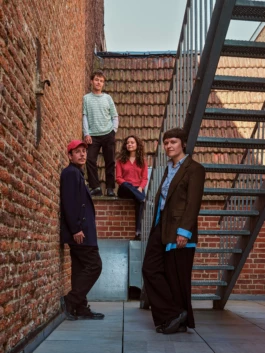
Mire operates as an open collective, bringing together a core group of four independent practitioners: Gaël Biache, Clémence Charpenet, Lucile De Gori and Lénaïck Kunze. Depending on the project, this core group is joined by architects, craftspeople, researchers and designers, combining complementary skills and perspectives.
We develop our projects in dialogue with a diverse range of clients and partners from the cultural, public and private sectors, in France and Belgium. These collaborations enrich our approach and allow us to bring together the expertise best suited to each project.
Lénaïck Kunze is a registered architect (HMONP). His trajectory engages with the essential value of what already exists, as well as with cultural, historical and contextual grounding, and an economy of means; his work is consistently driven by the theoretical question of “doing better with less.” He collaborates as an independent architect with several practices in France and Belgium (HBAAT, WALT and Studio Jan Vermeulen) on large-scale cultural, office and housing projects. In parallel, he occasionally takes on commissions and develops spontaneous artistic projects in the fields of graphic design and analogue photography. He founded the label mire in November 2021, following a first commission in the Vosges mountains, where he is originally from.
Lucile De Gori is a registered architect (HMONP) and painter whose work reflects a harmonious fusion between architecture and landscape. Drawn to forms, structures, and the unattainable natural magnificence of her surroundings, she shapes a tangible reality from Paris within the Office of Landscape Morphology. This philosophy guides both her artistic (sound and pictorial) and architectural projects, enabling her to create spaces and works that resonate with those who experience them. Her painting practice, blending flat tones and gradients, transcends the boundaries between artistic and architectural disciplines.
Clémence Charpenet is a graduate architect, cabinetmaker, and carpenter with a BP certification from the Compagnons du Devoir in Lille. Driven by a desire to contribute to a reality that inseparably links gesture and material through making, she is dedicated to developing a multiscalar craftsmanship. As an independent artisan, she collaborates with various actors in the fields of carpentry, heritage restoration, and furniture design. She has also contributed to the creation of set designs for advertisements and private or commercial interiors.
Gaël Biache is a registered architect (HMONP). He has worked within architecture practices in France and Belgium (Un1on and, for the past four years, Dierendonckblancke architecten) on cultural projects, social housing, and international competitions (Collectie Centrum Antwerpen, 2023). More recently, he has been leading and supervising the renovation of an industrial building into an artist’s studio in the Brussels region. His professional practice is diverse, spanning architecture, art, podcasting, and writing. Across these different fields, he consistently engages with the notion of inhabitation. In his work, inhabitation is not limited to the domestic sphere; it operates across all scales, from housing to the city and up to the broader territory. He questions the ways we inhabit the world and explores how redefining its boundaries can help us better understand it.

ICA-WB
CID Grand Hornu
Mundaneum
Commune de Fresse-sur-Moselle
Département des Vosges
Vincent Lelièvre
Mozart Groupe
Citya Descampiaux
Thomas Berthier
Johan Michel
Tanguy Dehaudt
Clément Guérard-Ortelli
Benjamin Muzart
VERA collective
Camille Mézi-Fardin
Imaginair Art/space
Roméo Drege
mire est un label d’architecture et de création spatiale basé entre Bruxelles et Paris.
De la transformation architecturale à la scénographie d’exposition, en passant par le mobilier et les installations culturelles, le studio développe des projets attentifs à leur contexte, à leurs usages et aux ressources disponibles.
Notre approche associe architecture essentielle, économie de moyens et précision constructive, avec une attention particulière à la matière et aux savoir-faire. Nous privilégions une approche raisonnée, qui valorise les ressources existantes et cherche à tirer le meilleur parti de chaque moyen engagé.
mire réunit un noyau de praticiens indépendants et un réseau de collaborateurs, reliant conception et fabrication pour accompagner chaque projet de l’esquisse à la réalisation.
contact@studiomire.com
instagram

Nous concevons et réalisons des projets dans les domaines de l'architecture et de la culture, de la rénovation et de la transformation de bâtiments à la scénographie d’exposition, aux installations et à l’aménagement d’espaces publics. Notre pratique s’étend également à la recherche, au mobilier sur mesure, de la conception à la fabrication.
Mire fonctionne comme un groupe ouvert, animé par un noyau de quatre praticiens indépendants : Gaël Biache, Clémence Charpenet, Lucile De Gori et Lénaïck Kunze. Selon les projets, ce noyau s’enrichit de collaborations avec des architectes, artisans, chercheurs et designers, réunis autour de compétences et de sensibilités complémentaires.
Nous développons nos projets en dialogue avec une diversité de commanditaires et de partenaires, issus des secteurs culturel, public et privé, en France comme en Belgique. Ces collaborations croisées enrichissent notre approche et permettent de réunir les compétences adaptées à chaque projet.
Lénaïck Kunze est architecte HMONP. Son parcours s’intéresse aux notions d’essentialité du déjà-là, d’ancrage culturel, historique et contextuel, ainsi qu’à l’économie des moyens ; il est constamment animé par la question théorique du « faire mieux avec moins ». Il a collaboré en tant qu’indépendant avec plusieurs agences d’architecture en France et en Belgique (HBAAT, WALT et Studio Jan Vermeulen) sur des projets culturels, tertiaires et de logements de grande échelle. En parallèle, il répond occasionnellement à des commandes et développe des projets artistiques spontanés dans le domaine du graphisme et de la photographie argentique. Il fonde le label mire en novembre 2021 à l’occasion d’une première commande au cœur du massif vosgien, d’où il est originaire.
Lucile De Gori est architecte HMONP et artiste peintre, son travail reflète une fusion harmonieuse entre l’architecture et le paysage. Attirée par les formes, les structures et l’inatteignable magnificence naturelle de son environnement, elle fabrique une réalité tangible depuis Paris auprès de l’Office of Landscape Morphology. Cette philosophie guide ses projets artistiques (sonores et picturaux) et architecturaux, et lui permet de créer des espaces et des œuvres qui résonnent avec ceux qui les expérimentent. Son travail de peinture, mélange d’aplats et de dégradés, transcende les frontières entre les disciplines artistiques et architecturales.
Clémence Charpenet est architecte diplômée d’Étude, ébéniste et menuisière titulaire d’un BP auprès des Compagnons du Devoirs de Lille. Soucieuse de contribuer par ses projets à l’élaboration d’une réalité liant indissociablement le geste et la matière par le faire, elle est engagée dans le développement d’un artisanat multiscalaire. En tant qu’indépendante, elle collabore avec différents acteurs dans les domaines de la menuiserie, de la restauration de patrimoine, et du design de mobilier. Elle a également participé à la création de décors de pub et d’agencements privés ou commerciaux.
Gaël Biache est architecte HMONP. Il a exercé au sein d’agences d’architecture en France et en Belgique (Un1on et, depuis quatre ans, pour Dierendonckblancke architecten) sur des projets culturels, de logements sociaux ou des concours internationaux (Collectie Centrum Antwerpen, 2023). Récemment, il réalise et suit les travaux pour la rénovation d’un bâtiment industriel en atelier pourartiste en région bruxelloise. Sa pratique de la profession est diverse : architecture, art, podcast ou écriture. Ces différentes facettes abordent à chaque fois la notion d’habité. Dans son travail, l’habité n’est pas uniquement réservé à laquestion domestique. Il traverse toutes les échelles, du logement à la ville jusqu’au grand territoire : ils’interroge sur nos manières d’habiter le monde, sur la façon d’en redessiner les limites pour mieux le comprendre.
ICA-WB
CID Grand Hornu
Mundaneum
Commune de Fresse-sur-Moselle
Département des Vosges
Vincent Lelièvre
Mozart Groupe
Citya Descampiaux
Thomas Berthier
Johan Michel
Tanguy Dehaudt
Clément Guérard-Ortelli
Benjamin Muzart
VERA collective
Camille Mézi-Fardin
Imaginair Art/space
Roméo Drege

mire is an architecture and spatial design label based between Brussels and Paris.
From architectural transformation to exhibition scenography, furniture and cultural installations, the studio develops projects that respond to their context, uses and available resources.
Our approach combines essential architecture, a conscious economy of means and constructive precision, with particular attention to materials and craftsmanship. We seek to make the most of existing resources and achieve more with the means available.
mire brings together a core group of independent practitioners and a network of collaborators, connecting design and making to guide each project from initial concept to completion.
We develop and deliver projects across architecture and culture, from building renovation and transformation to exhibition scenography, installations and public space design. Our practice also encompasses research and bespoke furniture, from design through to fabrication.
Mire operates as an open collective, bringing together a core group of four independent practitioners: Gaël Biache, Clémence Charpenet, Lucile De Gori and Lénaïck Kunze. Depending on the project, this core group is joined by architects, craftspeople, researchers and designers, combining complementary skills and perspectives.
We develop our projects in dialogue with a diverse range of clients and partners from the cultural, public and private sectors, in France and Belgium. These collaborations enrich our approach and allow us to bring together the expertise best suited to each project.

Lénaïck Kunze is a registered architect (HMONP). His trajectory engages with the essential value of what already exists, as well as with cultural, historical and contextual grounding, and an economy of means; his work is consistently driven by the theoretical question of “doing better with less.” He collaborates as an independent architect with several practices in France and Belgium (HBAAT, WALT and Studio Jan Vermeulen) on large-scale cultural, office and housing projects. In parallel, he occasionally takes on commissions and develops spontaneous artistic projects in the fields of graphic design and analogue photography. He founded the label mire in November 2021, following a first commission in the Vosges mountains, where he is originally from.
Lucile De Gori is a registered architect (HMONP) and painter whose work reflects a harmonious fusion between architecture and landscape. Drawn to forms, structures, and the unattainable natural magnificence of her surroundings, she shapes a tangible reality from Paris within the Office of Landscape Morphology. This philosophy guides both her artistic (sound and pictorial) and architectural projects, enabling her to create spaces and works that resonate with those who experience them. Her painting practice, blending flat tones and gradients, transcends the boundaries between artistic and architectural disciplines.
Clémence Charpenet is a graduate architect, cabinetmaker, and carpenter with a BP certification from the Compagnons du Devoir in Lille. Driven by a desire to contribute to a reality that inseparably links gesture and material through making, she is dedicated to developing a multiscalar craftsmanship. As an independent artisan, she collaborates with various actors in the fields of carpentry, heritage restoration, and furniture design. She has also contributed to the creation of set designs for advertisements and private or commercial interiors.
Gaël Biache is a registered architect (HMONP). He has worked within architecture practices in France and Belgium (Un1on and, for the past four years, Dierendonckblancke architecten) on cultural projects, social housing, and international competitions (Collectie Centrum Antwerpen, 2023). More recently, he has been leading and supervising the renovation of an industrial building into an artist’s studio in the Brussels region. His professional practice is diverse, spanning architecture, art, podcasting, and writing. Across these different fields, he consistently engages with the notion of inhabitation. In his work, inhabitation is not limited to the domestic sphere; it operates across all scales, from housing to the city and up to the broader territory. He questions the ways we inhabit the world and explores how redefining its boundaries can help us better understand it.
ICA-WB
CID Grand Hornu
Mundaneum
Commune de Fresse-sur-Moselle
Département des Vosges
Vincent Lelièvre
Mozart Groupe
Citya Descampiaux
Thomas Berthier
Johan Michel
Tanguy Dehaudt
Clément Guérard-Ortelli
Benjamin Muzart
VERA collective
Camille Mézi-Fardin
Imaginair Art/space
Roméo Drege

mire est un label d’architecture et de création spatiale basé entre Bruxelles et Paris.
De la transformation architecturale à la scénographie d’exposition, en passant par le mobilier et les installations culturelles, le studio développe des projets attentifs à leur contexte, à leurs usages et aux ressources disponibles.
Notre approche associe architecture essentielle, économie de moyens et précision constructive, avec une attention particulière à la matière et aux savoir-faire. Nous privilégions une approche raisonnée, qui valorise les ressources existantes et cherche à tirer le meilleur parti de chaque moyen engagé.
mire réunit un noyau de praticiens indépendants et un réseau de collaborateurs, reliant conception et fabrication pour accompagner chaque projet de l’esquisse à la réalisation.
Nous concevons et réalisons des projets dans les domaines de l'architecture et de la culture, de la rénovation et de la transformation de bâtiments à la scénographie d’exposition, aux installations et à l’aménagement d’espaces publics. Notre pratique s’étend également à la recherche, au mobilier sur mesure, de la conception à la fabrication.
Mire fonctionne comme un groupe ouvert, animé par un noyau de quatre praticiens indépendants : Gaël Biache, Clémence Charpenet, Lucile De Gori et Lénaïck Kunze. Selon les projets, ce noyau s’enrichit de collaborations avec des architectes, artisans, chercheurs et designers, réunis autour de compétences et de sensibilités complémentaires.
Nous développons nos projets en dialogue avec une diversité de commanditaires et de partenaires, issus des secteurs culturel, public et privé, en France comme en Belgique. Ces collaborations croisées enrichissent notre approche et permettent de réunir les compétences adaptées à chaque projet.

Lénaïck Kunze est architecte HMONP. Son parcours s’intéresse aux notions d’essentialité du déjà-là, d’ancrage culturel, historique et contextuel, ainsi qu’à l’économie des moyens ; il est constamment animé par la question théorique du « faire mieux avec moins ». Il a collaboré en tant qu’indépendant avec plusieurs agences d’architecture en France et en Belgique (HBAAT, WALT et Studio Jan Vermeulen) sur des projets culturels, tertiaires et de logements de grande échelle. En parallèle, il répond occasionnellement à des commandes et développe des projets artistiques spontanés dans le domaine du graphisme et de la photographie argentique. Il fonde le label mire en novembre 2021 à l’occasion d’une première commande au cœur du massif vosgien, d’où il est originaire.
Lucile De Gori est architecte HMONP et artiste peintre, son travail reflète une fusion harmonieuse entre l’architecture et le paysage. Attirée par les formes, les structures et l’inatteignable magnificence naturelle de son environnement, elle fabrique une réalité tangible depuis Paris auprès de l’Office of Landscape Morphology. Cette philosophie guide ses projets artistiques (sonores et picturaux) et architecturaux, et lui permet de créer des espaces et des œuvres qui résonnent avec ceux qui les expérimentent. Son travail de peinture, mélange d’aplats et de dégradés, transcende les frontières entre les disciplines artistiques et architecturales.
Clémence Charpenet est architecte diplômée d’Étude, ébéniste et menuisière titulaire d’un BP auprès des Compagnons du Devoirs de Lille. Soucieuse de contribuer par ses projets à l’élaboration d’une réalité liant indissociablement le geste et la matière par le faire, elle est engagée dans le développement d’un artisanat multiscalaire. En tant qu’indépendante, elle collabore avec différents acteurs dans les domaines de la menuiserie, de la restauration de patrimoine, et du design de mobilier. Elle a également participé à la création de décors de pub et d’agencements privés ou commerciaux.
Gaël Biache est architecte HMONP. Il a exercé au sein d’agences d’architecture en France et en Belgique (Un1on et, depuis quatre ans, pour Dierendonckblancke architecten) sur des projets culturels, de logements sociaux ou des concours internationaux (Collectie Centrum Antwerpen, 2023). Récemment, il réalise et suit les travaux pour la rénovation d’un bâtiment industriel en atelier pourartiste en région bruxelloise. Sa pratique de la profession est diverse : architecture, art, podcast ou écriture. Ces différentes facettes abordent à chaque fois la notion d’habité. Dans son travail, l’habité n’est pas uniquement réservé à laquestion domestique. Il traverse toutes les échelles, du logement à la ville jusqu’au grand territoire : ils’interroge sur nos manières d’habiter le monde, sur la façon d’en redessiner les limites pour mieux le comprendre.
ICA-WB
CID Grand Hornu
Mundaneum
Commune de Fresse-sur-Moselle
Département des Vosges
Vincent Lelièvre
Mozart Groupe
Citya Descampiaux
Thomas Berthier
Johan Michel
Tanguy Dehaudt
Clément Guérard-Ortelli
Benjamin Muzart
VERA collective
Camille Mézi-Fardin
Imaginair Art/space
Roméo Drege